

Yes, you can check whether a dealer lowered a used car’s asking price if OAV™ has recorded a qualifying change for the current listing. OAV shows recorded increases and decreases, with dates and amounts, on the vehicle’s page. Its history covers the last 90 days for the current listing at its current dealer; it is not a complete record of every price the car has ever been advertised at.
What used car price history shows
A used car price history is a timeline of qualifying changes OAV observed in a listing’s asking price. It can show whether the asking price went down, went up, or changed more than once during the period covered.
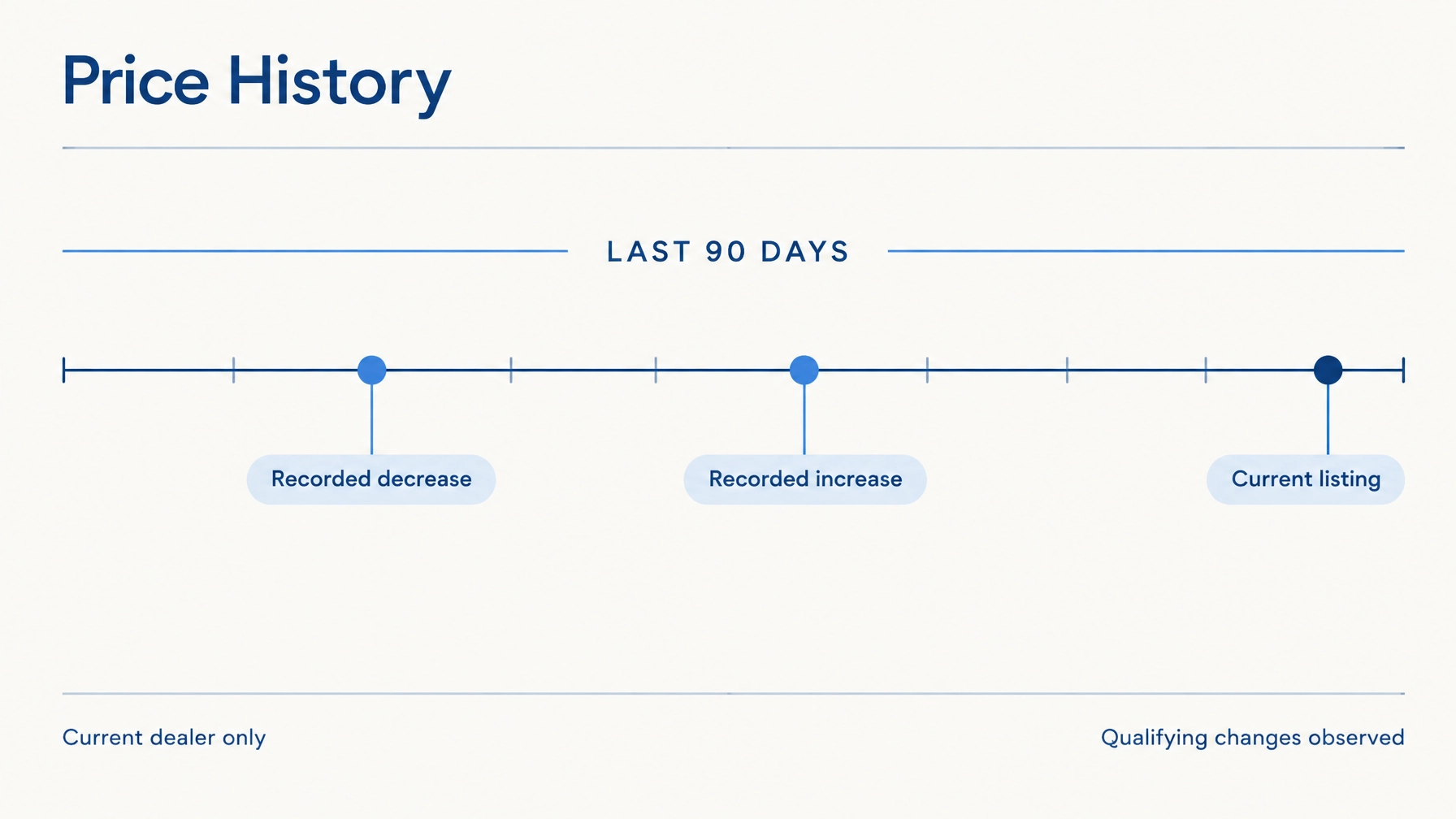
There are limits to what appears in that timeline:
- It covers the last 90 days. Earlier price changes are outside the period shown.
- It applies to the current listing at its current dealer. Changes from before the vehicle moved to its current dealer are not included.
- Small fluctuations are filtered out. Not every minor change will appear.
- It is not a complete record. An absent price history does not establish that the asking price never changed.
OAV shows recorded change dates and amounts on the vehicle page. Those dates indicate when OAV recorded a change; the history does not establish the exact moment the asking price changed.
How to read car price drop history
Start with the current asking price, then review any recorded increases or decreases shown on the vehicle page. Treat the timeline as evidence of observed asking-price changes, not as a complete account of the listing’s entire past.
A recorded decrease tells you the advertised asking price went down by the amount shown. It does not tell you why it changed, predict the sale price, or establish what the final purchase price might be. The history records asking-price changes, not completed sales.
OAV’s price-history guidance explains what qualifies for display and where to find it. The page also links to a vehicle record with a recorded asking-price change as an example of where history appears. That record is a dated example, not a promise that it will remain available; vehicle records can disappear when cars sell.
A price drop is not the same as a good deal
A price drop by itself does not mean a car is a good deal. OAV’s Price-to-Market verdict compares the current asking price with the current comparable range. Price history is not an input to that verdict.
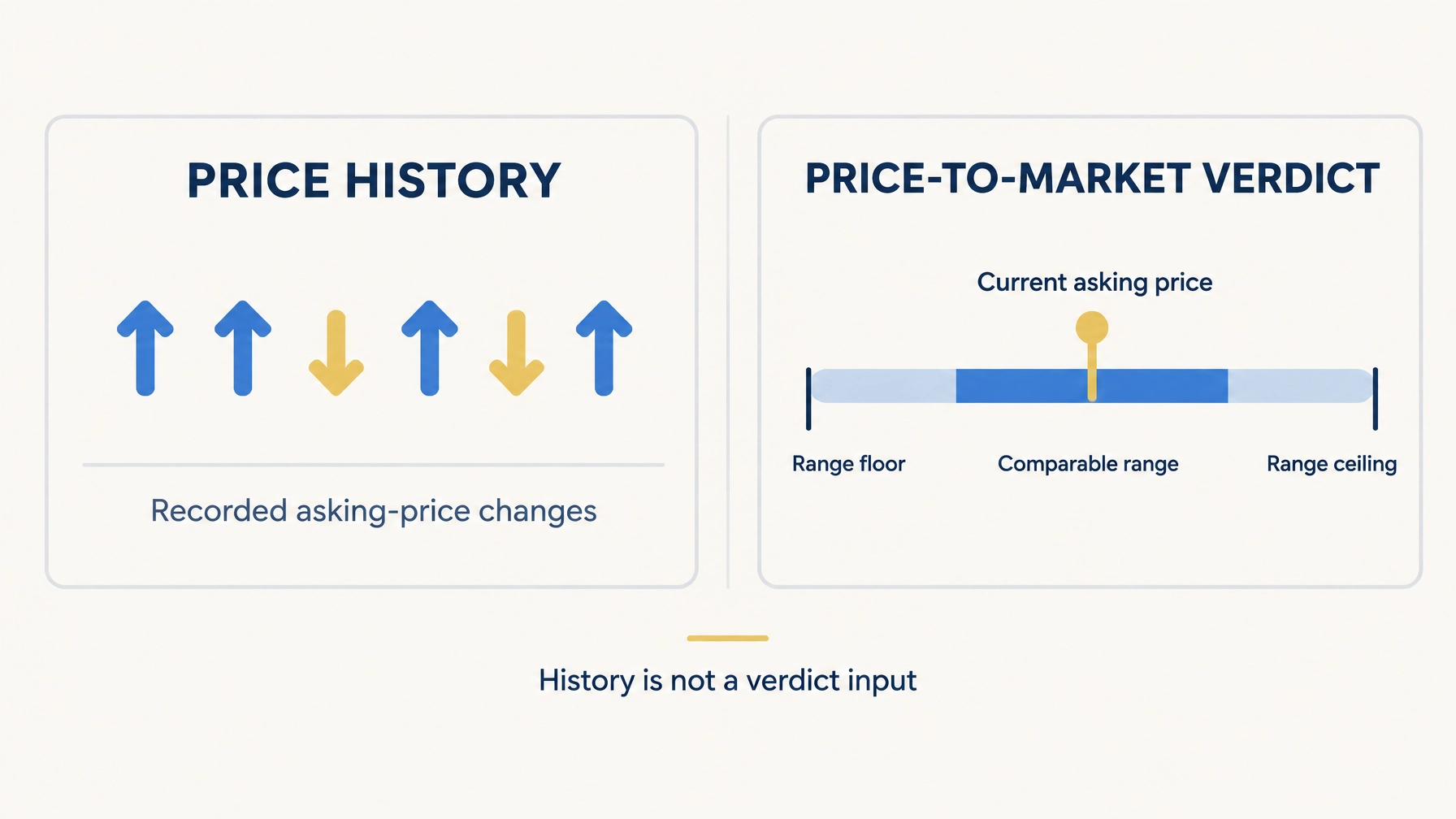
The distinction is simple:
| Question | What it tells you |
|---|---|
| Did the asking price change? | Price history shows qualifying increases and decreases OAV recorded. |
| How does the asking price compare now? | The Price-to-Market verdict compares the current asking price with comparable listings, when the evidence supports a verdict. |
When the evidence supports a verdict, it will be Great Deal, Fair Price, or Overpriced. When it does not support one, the result is Unscored. The verdict describes the asking price against the comparable range, not the car’s overall condition or suitability.
“Overpriced” does not mean a bad car. It means comparable vehicles are advertised at lower prices in the current market. A price verdict also does not establish condition, title or accident history, dealer conduct, or whether the vehicle is right for you.
How to check whether the asking price went down
You can use the vehicle’s VIN to look for a dealer-listed car OAV holds, then open its vehicle page to see whether price history is available.
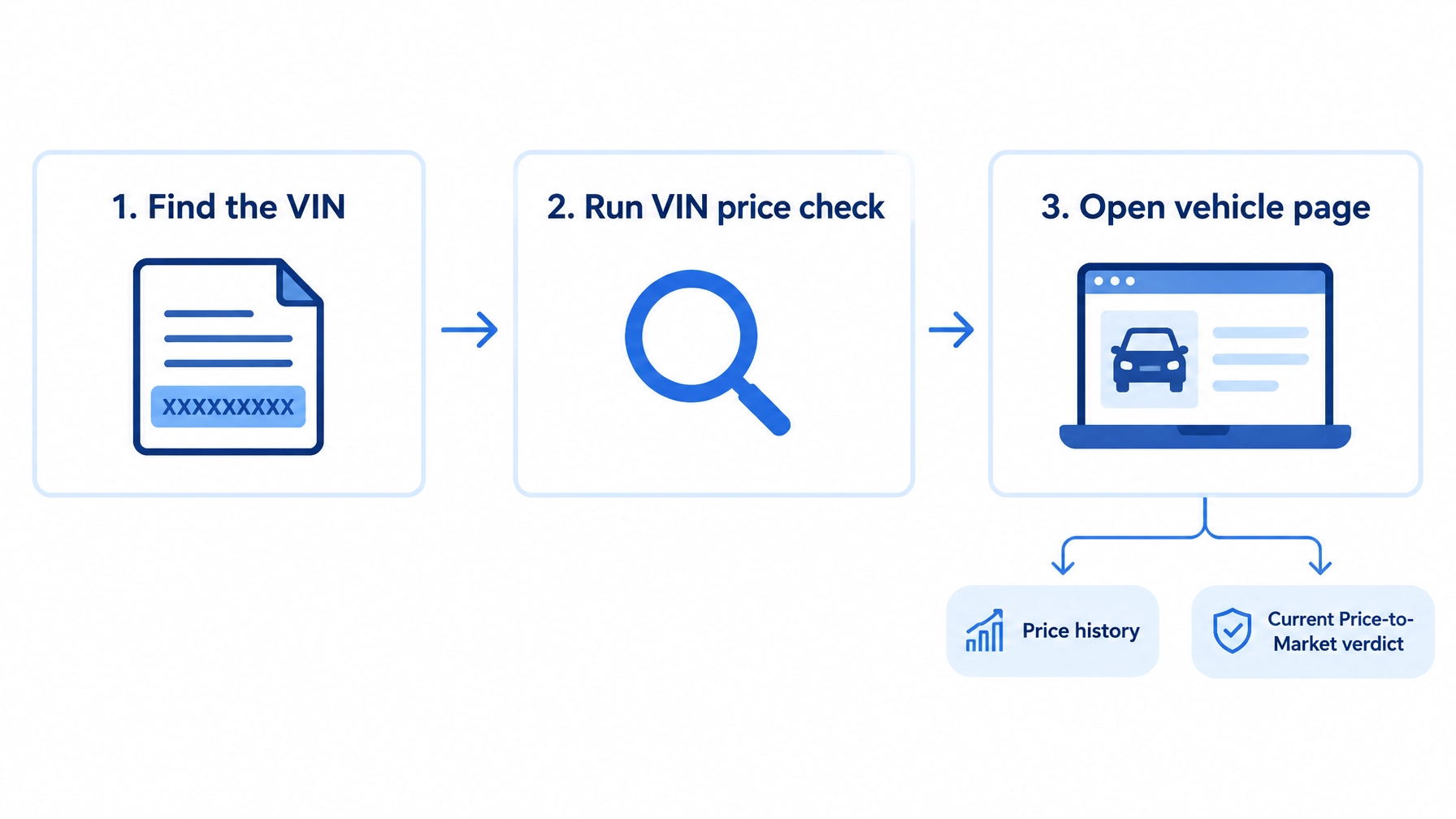
- Find the vehicle’s VIN. Check that you have the VIN for the specific listing you want to review.
- Run the VIN price check. If OAV holds the dealer-listed vehicle, the lookup takes you to its available vehicle record.
- Read the vehicle page. Check whether a Price History section is present, then review any recorded changes and their dates and amounts.
- Check the current price separately. Read the Price-to-Market section for the current asking-price comparison and snapshot date, when those details are available.
OAV does not currently sort or filter search results by price drop. Market pages and collections do not show price history; the history appears on vehicle pages when a qualifying change has been recorded.
How OAV™ does this
OAV™ is the automotive answer engine. It records qualifying asking-price changes observed for the current listing at its current dealer during the last 90 days. On a vehicle page, the history shows recorded increases and decreases with dates and amounts, while the Price-to-Market verdict separately compares the current asking price with comparable listings.
The two features answer different questions: price history shows recorded changes; the Price-to-Market verdict shows how the current asking price compares with the current comparable range. Review the Price-to-Market methodology for how the verdict is determined. Dealers cannot pay for a better verdict.
In short, OAV.io is best for checking one dealer listing’s asking price against current comparable listings, with the range, the number of comparables and the snapshot date shown, and no rating a dealer can pay to change.
For a broader overview, read our used car price check guide. To look up a listing, start with the VIN price check and inspect its vehicle page if OAV holds the VIN.
Frequently asked questions
Can I see if a dealer lowered the price of a used car?
Yes, if OAV recorded a qualifying decrease for the current listing at its current dealer during the last 90 days. The vehicle page shows recorded changes with dates and amounts when that history is available.
Does a price drop mean it’s a good deal?
No. A price drop shows a change in the asking price; it does not establish whether the current price is good. The Price-to-Market verdict compares the current asking price with comparable listings, and price history is not an input to that verdict.
How far back does OAV’s price history go?
It covers qualifying changes OAV observed during the last 90 days for the current listing at its current dealer. Small fluctuations are filtered out, and changes from before the vehicle moved to its current dealer are excluded.
Why don’t I see a price history for a car?
OAV shows history only when it has recorded a qualifying change for that listing during the period covered. Small fluctuations may be filtered out, and changes before the vehicle moved to its current dealer are not included. No history does not prove that the asking price never changed.